
Quick Read
The Green Claims Directive's withdrawal removed the mandatory verification requirement for environmental claims, but the Empowering Consumers for the Green Transition Directive (EmpCo), effective 27 September 2026, now prohibits unsubstantiated environmental claims and enforces compliance through post-market action by national consumer authorities with penalties reaching four per cent of turnover. Speeki's two-layer model addresses this shift: layer one verifies the accuracy of the underlying inventory data, while layer two assures the truthfulness of the disclosure itself—two distinct functions that neither substitute for the other. Companies must now treat verification as defensive evidence to demonstrate claim substantiation when challenged by regulators, competitors, or NGOs, rather than as a pre-publication gate.
IN BRIEF
The EU Green Claims Directive proposal, which would have required ex-ante verification of environmental claims by an accredited third party, was suspended in June 2025 when the Commission announced its intention to withdraw it and the final trilogue was cancelled.
Directive (EU) 2024/825, the Empowering Consumers for the Green Transition Directive (EmpCo), is already law and applies from 27 September 2026. It prohibits generic environmental claims, offset-based product-level climate neutrality claims, and self-created sustainability labels not based on third-party certification criteria. Penalties reach 4% of annual turnover.
GHG verification under ISO 14064-1, ISO 14067 and ISO 14068-1 is performed by bodies accredited under ISO/IEC 17029. It tests whether the emissions figure is right.
Sustainability assurance under ISSA 5000, effective for periods beginning on or after 15 December 2026, tests whether the disclosure about the figure is materially misstated. ISAE 3410, the previous GHG assurance standard, is withdrawn from that date.
A verified inventory that is misdescribed in the report remains a misleading claim. An accurately described inventory that was never verified has no evidence behind it.
Executive summary
In March 2023 the European Commission proposed the Green Claims Directive. It would have required that every explicit environmental claim be substantiated by science, assessed across a life cycle, and verified by an accredited independent third party before publication. Companies objected that this amounted to a licensing regime for marketing copy. They were right, and they won: the Commission announced its intention to withdraw the proposal on 20 June 2025, and the final trilogue negotiation was cancelled three days later.
Most sustainability teams filed this under good news. It is not.
The instrument that would have compelled verification is dead. The instrument that punishes its absence is alive and applies on 27 September 2026. The Empowering Consumers for the Green Transition Directive was adopted in February 2024, entered into force in March 2024, and prohibits generic environmental claims, offset-based product climate neutrality labels, and self-created sustainability labels. Enforcement is post-market, by national consumer protection authorities, under a framework that reaches four per cent of turnover.
WHAT ACTUALLY CHANGED ON 20 JUNE 2025
Before: verification would have been a gate you passed through before making a claim, and passing it was your compliance. After: verification is a defence you assemble in advance, and the absence of it is what a regulator finds when the claim is challenged.
This paper sets out the two-layer model that follows. Layer one verifies the inventory: is the number right? Layer two assures the disclosure: is what you said about the number right? Companies routinely buy one and assume they have bought both.
1. The verification requirement that disappeared, and the prohibition that did not
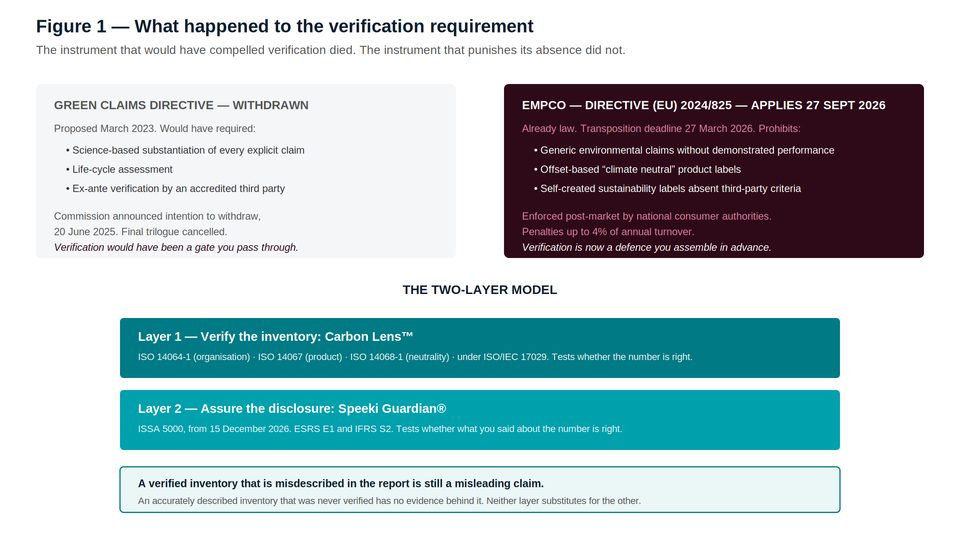
Figure 1 — The instrument that would have compelled verification died. The instrument that punishes its absence did not.
The procedural detail matters, because a great many companies believe the position is more relaxed than it is.
Green Claims Directive | EmpCo — Directive (EU) 2024/825 | |
|---|---|---|
Status | Proposed March 2023. Commission announced intention to withdraw, 20 June 2025. Final trilogue cancelled. Not formally terminated; legislative process dormant. | Adopted February 2024. In force March 2024. Transposition deadline 27 March 2026. Applies 27 September 2026. |
Mechanism | Ex-ante: substantiate and verify before making the claim | Post-market: make the claim and defend it when challenged |
Verification | Mandatory, by an accredited third party | Not mandated. But claims must be demonstrated, and self-created labels are prohibited unless based on third-party certification criteria. |
What it prohibits | Unsubstantiated explicit environmental claims | Generic environmental claims without demonstrated excellent performance; offset-based product-level climate neutrality claims; sustainability labels not based on a certification scheme |
Enforcement | Would have been by designated verifiers | National consumer protection authorities, under the Unfair Commercial Practices framework |
Penalty | Envisaged at least 4% of turnover | Up to 4% of annual turnover in the relevant Member State |
Read the verification row twice. Under the Green Claims Directive, an accredited verification statement would have been the thing that let you publish. Under EmpCo, no verification is required to publish anything. Verification is now the evidence you produce when a consumer authority, a competitor or an NGO asks how you know.
A regime of ex-ante verification protects the company that verifies. A regime of post-market enforcement punishes the company that did not.
The offsetting prohibition
The provision with the sharpest commercial edge is the prohibition on product-level climate neutrality claims based on offsetting. From 27 September 2026, a claim that a product is "climate neutral", "CO₂ neutral", or has a reduced greenhouse gas footprint, where that claim rests on the purchase of carbon credits rather than on emissions reduction, is prohibited in business-to-consumer communication across the EU.
This is not a labelling technicality. Entire product marketing architectures have been built on offset-based neutrality claims, and the ISO 14068-1 standard for carbon neutrality expressly contemplates the use of offsetting alongside reduction. A company may still achieve and claim carbon neutrality under ISO 14068-1 at organisational level, and may still purchase credits. What it may not do, from September, is put an offset-derived neutrality label on a product in front of a consumer.
THE ELEVEN-WEEK QUESTION
Every product carrying a climate neutrality or reduced-footprint label in an EU market needs, before 27 September 2026, a documented answer to one question: is this claim derived from reduction, or from offsetting? If nobody can answer it from a verified inventory, the claim comes off the packaging.
2. Layer one: verifying the inventory
Verification, governed by ISO/IEC 17029, is the independent examination of a claim against a specified standard by a body accredited for that scheme. For greenhouse gases the relevant standards are well established, and they are not interchangeable.
Term | Definition |
|---|---|
ISO 14064-1 | Specification with guidance at the organisation level for quantification and reporting of greenhouse gas emissions and removals. Verifies the corporate inventory: Scope 1, Scope 2, and the Scope 3 categories included. |
ISO 14067 | Specification for the quantification of the carbon footprint of products. Verifies a product-level footprint on a life-cycle basis. This is the standard that supports a product claim. |
ISO 14068-1 | Specification for carbon neutrality. Sets requirements for achieving and demonstrating carbon neutrality for a subject, including the hierarchy of reduction before offsetting. |
ISO/IEC 17029 | The accreditation standard governing validation and verification bodies. Determines whether the verifier is competent and independent, and is what makes a verification statement worth anything to a third party. |
Verification statement | The output. A statement that a specified claim, quantified in accordance with a specified standard, is materially correct at a stated level of assurance. |
Two errors recur, and both are expensive.
Verifying the organisation and claiming for the product. An ISO 14064-1 verification examines the corporate inventory. It says nothing about the life-cycle footprint of any individual product. A company that holds a 14064-1 statement and prints a carbon figure on a package has not verified that figure. From 27 September 2026 it has also, on the face of EmpCo, made a product-level environmental claim it cannot demonstrate at product level.
Treating verification as an annual event. A verification statement attaches to a specific inventory for a specific period, prepared on a specific boundary. Change the consolidation approach, acquire a business, or restate a base year, and the statement does not travel with the number. Marketing material citing a verified figure two years after the verification is citing an unverified figure.
3. Layer two: assuring the disclosure
From 15 December 2026, ISSA 5000 governs assurance engagements on sustainability information for periods beginning on or after that date. Greenhouse gas emissions are sustainability information as defined by the standard, and ISAE 3410 — which previously governed GHG assurance engagements — is withdrawn from the same date. ISSA 5000 is standalone: practitioners applying it do not additionally apply ISAE 3000 (Revised).
The distinction between the layers is not one of rigour. It is one of subject matter.
Verification (Carbon Lens™) | Assurance (Speeki Guardian®) | |
|---|---|---|
Governing standard | ISO/IEC 17029, against ISO 14064-1, 14067 or 14068-1 | ISSA 5000 |
Subject matter | The GHG inventory or the product footprint | The sustainability disclosure containing it, including narrative |
Question answered | Is the number right? | Is what you said about the number materially misstated? |
What it catches | Wrong emission factors, boundary errors, omitted sources, double counting | A verified figure described as "reduced" when the reduction came from a divestment; a target presented as science-based that was never validated; a comparative silently restated |
What it cannot catch | A correct number that is misdescribed in the report | A misstated number that the practitioner was not required to test, in a limited engagement |
Applies to | The claim | The report about the claim |
Why the second layer exists
Consider a company whose absolute Scope 1 and 2 emissions fell 30% because it sold its most carbon-intensive division.
The inventory is correct. The verification statement is clean and properly issued.
The sustainability report says: "We reduced our emissions by 30%."
Verification has nothing to say about that sentence. Assurance does.
This is the case that companies find counter-intuitive and regulators find familiar. Verification is an examination of a quantity. Assurance is an examination of an assertion. Most greenwashing enforcement concerns assertions, not quantities, because quantities are rarely simply invented and assertions are constructed by people whose job is persuasion.
4. How the layers sit together
The sequencing is not a matter of preference. Assurance under ISSA 5000 requires the practitioner to obtain an understanding of the entity's process for preparing the information and to consider risks of material misstatement. Where the underlying inventory has already been verified by an accredited body against a published standard, that understanding is available from an independent source, and the practitioner's risk assessment starts from a materially better position.
Verify first, within the reporting period. An inventory verification conducted while the period is still running identifies boundary and data errors in time to correct them. Conducted afterwards, it identifies them in time to disclose them.
Assure second, on the verified base. The ISSA 5000 practitioner examines the disclosure, the narrative and the materiality determination, resting on a quantum that a third party has already tested.
Do not substitute. A limited assurance conclusion over a sustainability statement is not a verification of the GHG inventory inside it, because in a limited engagement the practitioner is not required to test the operating effectiveness of the controls that produced it.
Where the layers meet the claim
For a company making product-level environmental claims into the EU consumer market, the chain is now four links long, and it breaks at whichever link was never built.
Link | What it is | What it protects against |
|---|---|---|
1 | Product footprint quantified under ISO 14067, on a documented life-cycle basis | The claim being unsupported by any calculation |
2 | Verified by a body accredited under ISO/IEC 17029 | The calculation being unexamined, and the label being self-created — prohibited by EmpCo from 27 September 2026 |
3 | The claim wording tested against the verified quantity — reduction, not offsetting | The offset-based neutrality prohibition, and the generic-claim prohibition |
4 | The corporate disclosure about the claim assured under ISSA 5000 | The narrative overstating what the verified figure shows |
THE AUDIT TRAIL A CONSUMER AUTHORITY WILL ASK FOR
Not the marketing brief. The calculation, the standard it was prepared under, the identity and accreditation of the body that verified it, the date of the verification, the boundary it applied, and the document showing that the claim wording was tested against the verified result before publication.
5. What to do before 27 September 2026
Inventory the claims. Every environmental claim made to an EU consumer, on packaging, in advertising, on the website, in a product page, in a sustainability label. Most companies do not have this list and are surprised by its length.
Classify each claim as generic or specific. Generic claims — "eco-friendly", "green", "environmentally responsible" — are prohibited from 27 September 2026 unless recognised excellent environmental performance is demonstrated. Most will simply have to be withdrawn.
Identify every neutrality or reduced-footprint claim and trace it to a source. If the source is offsetting and the claim is at product level in a consumer context, it is prohibited.
Identify every sustainability label the company created itself. Prohibited unless established under a certification scheme with third-party verification of compliance.
For every surviving claim, obtain or refresh a verification against the applicable ISO standard, from a body accredited under ISO/IEC 17029.
Document, before publication, that the claim wording was tested against the verified quantity. This is the artefact a regulator will ask for and that almost nobody creates.
Bring the corporate disclosures about the claims into the ISSA 5000 assurance scope, so that the narrative describing them is examined rather than assumed.
The Green Claims Directive would have made verification a cost of doing business. Its withdrawal made verification a competitive and legal advantage instead. That is a worse outcome for the companies that skipped it.
6. Where Carbon Lens® and Speeki Guardian® fit
Carbon Lens® is GHG verification under ISO/IEC 17029, against ISO 14064-1 at organisation level, ISO 14067 at product level, and ISO 14068-1 for neutrality claims. It examines the quantity.
Speeki Guardian® is sustainability assurance under ISSA 5000. It examines the disclosure, the narrative, and the materiality determination that decided what to disclose.
Speeki is an accredited certification and assurance body and does not provide consulting services; details of its accreditations and their scope are published at speeki.com. The relevance of that separation to this paper is specific: under EmpCo, a sustainability label is prohibited unless it is established under a certification scheme with third-party verification of compliance. A verification performed by the firm that designed the claim is not third-party verification, whatever the engagement letter says, and a regulator asked to consider a four per cent penalty will look at the relationship before it looks at the methodology.
Questions this paper answers
Was the EU Green Claims Directive withdrawn?
The European Commission announced its intention to withdraw the Green Claims Directive proposal on 20 June 2025, following political pressure over the burden the ex-ante verification requirement would impose. The final trilogue negotiation scheduled for 23 June 2025 was cancelled. The proposal has not been formally terminated, but the legislative process is dormant and no timeline for revival has been published.
If the Green Claims Directive is gone, do environmental claims still need substantiation?
Yes. The Empowering Consumers for the Green Transition Directive, Directive (EU) 2024/825 (EmpCo), was adopted in February 2024, entered into force in March 2024, and applies from 27 September 2026. It prohibits generic environmental claims that cannot be demonstrated, prohibits product-level climate neutrality claims based on offsetting, and prohibits self-created sustainability labels not established under a certification scheme with third-party verification. Enforcement is by national consumer protection authorities, with penalties reaching 4% of annual turnover.
Can a product still be marketed as "climate neutral" in the EU?
Not on the basis of offsetting, in business-to-consumer communication, from 27 September 2026. EmpCo prohibits product-level claims that a good or service is climate neutral, CO₂ neutral, or has a reduced greenhouse gas footprint where the claim rests on the purchase of carbon credits rather than on emissions reduction. Organisational carbon neutrality claims under ISO 14068-1 are a separate matter, and the standard's reduction-before-offsetting hierarchy remains relevant to them.
What is the difference between GHG verification and sustainability assurance?
Verification, governed by ISO/IEC 17029 and performed against ISO 14064-1, ISO 14067 or ISO 14068-1, examines whether the greenhouse gas quantity is correct. Assurance, governed by ISSA 5000 from 15 December 2026, examines whether the disclosure about that quantity — including the narrative around it — is materially misstated. A verified inventory that is misdescribed in a report is still a misleading claim; verification has nothing to say about the sentence, and assurance does.
Does ISO 14064-1 verification support a product-level carbon claim?
No. ISO 14064-1 governs quantification and reporting of greenhouse gas emissions and removals at organisation level. Product-level footprints are quantified under ISO 14067 on a life-cycle basis. A company holding a 14064-1 verification statement that prints a carbon figure on a package has not verified that figure, and from 27 September 2026 has made a product-level environmental claim it cannot demonstrate at product level.
Is ISAE 3410 still used for GHG assurance?
No, other than where law or regulation in a jurisdiction requires it. The IAASB approved the withdrawal of ISAE 3410 in March 2025, with effect from the effective date of ISSA 5000. Greenhouse gas emissions are sustainability information as defined by ISSA 5000, and the IAASB concluded that ISSA 5000 is sufficiently comprehensive to address assurance engagements over GHG statements.
What should a company do before 27 September 2026?
Compile a complete inventory of environmental claims made to EU consumers. Withdraw generic claims that cannot demonstrate recognised excellent environmental performance. Trace every neutrality or reduced-footprint claim to its source and remove those derived from offsetting at product level. Remove self-created sustainability labels not established under a certification scheme. Obtain accredited verification against the applicable ISO standard for every surviving claim. And create a document, before publication, showing that the claim wording was tested against the verified quantity — the artefact a consumer authority will ask for and that almost nobody produces.
References and sources
Directive (EU) 2024/825, Empowering Consumers for the Green Transition (EmpCo), amending the Unfair Commercial Practices Directive and the Consumer Rights Directive. Adopted February 2024, in force March 2024, Member State transposition deadline 27 March 2026, applicable from 27 September 2026.
European Commission announcement of intention to withdraw the Green Claims Directive proposal, 20 June 2025; final trilogue negotiation cancelled 23 June 2025. The proposal has not been formally terminated.
Directive 2005/29/EC, the Unfair Commercial Practices Directive, as amended — the enforcement basis for action against unsubstantiated environmental claims at Member State level.
ISO 14064-1:2018, Greenhouse gases — Part 1: Specification with guidance at the organization level for quantification and reporting of greenhouse gas emissions and removals.
ISO 14067:2018, Greenhouse gases — Carbon footprint of products — Requirements and guidelines for quantification.
ISO 14068-1:2023, Climate change management — Transition to net zero — Part 1: Carbon neutrality.
ISO/IEC 17029:2019, Conformity assessment — General principles and requirements for validation and verification bodies.
IAASB, ISSA 5000, General Requirements for Sustainability Assurance Engagements, issued November 2024; effective for periods beginning on or after 15 December 2026. ISAE 3410 withdrawn with effect from that date, per IAASB approval in March 2025.
Speeki, What ESG Report Assurance Actually Requires (Whitepaper Series 2, Paper 07), July 2026.
About Speeki
Speeki is an accredited ESG assurance and certification body operating in more than 100 countries. Speeki provides management system certification, verification and validation, and sustainability assurance. Speeki does not provide consulting services. Its independence is structural.
For current details of Speeki's accreditations and their scope, please refer to speeki.com.
© 2026 Speeki. This paper is provided for general information and does not constitute legal, accounting or assurance advice.