

Quick Read
This whitepaper distinguishes between organisation-level circularity performance (governed by ISO 59020) and product-level circularity claims (governed by ISO 59040), establishing that entity-level verification does not substantiate product claims—a critical gap as EmpCo enforcement begins on 27 September 2026. The paper presents a claims taxonomy showing that circularity lacks the universal measurement standard that carbon possesses, creating significant exposure for organisations making unsubstantiated product-level environmental claims. Speeki's analysis demonstrates why product circularity claims require distinct verification engagement separate from organisation-level assurance.
IN BRIEF
ISO 59020 specifies requirements for measuring and assessing circularity performance of an economic system, including an organisation. It supports entity-level circularity disclosure, including ESRS E5.
ISO 59040 specifies the product circularity data sheet (PCDS), a structured set of attestable statements about a specific product. It supports product-level claims.
Both are verified under ISO/IEC 17029 by an accredited validation and verification body. They are not interchangeable, and a verification of one does not substantiate a claim under the other.
From 27 September 2026, Directive (EU) 2024/825 (EmpCo) prohibits generic environmental claims and self-created sustainability labels not established under a certification scheme with third-party verification of compliance. Penalties reach 4% of annual turnover.
Circularity claims are structurally more exposed than carbon claims, because "recyclable", "recycled content" and "circular" are made at product level, to consumers, on packaging, by people who have never seen the entity-level measurement.
Executive summary
Carbon has an advantage that circularity does not: everybody agrees what a tonne is. Circularity has no single unit, no universal denominator, and a vocabulary — recyclable, recycled, circular, closed-loop, renewable — that is used interchangeably in marketing and precisely nowhere else.
Into that ambiguity, two standards arrived. ISO 59020 governs the measurement and assessment of circularity performance for an economic system, which for most readers means the organisation. ISO 59040 governs the product circularity data sheet: a structured set of statements about a specific product, each of which can be attested and verified.
They answer different questions. ISO 59020 answers how circular is this business. ISO 59040 answers what is true about this item. And the exposure sits almost entirely on the second question, while the spending sits almost entirely on the first.
THE MISMATCH
The organisation-level measurement is procured because it feeds ESRS E5 in the sustainability report, which is read by analysts. The product-level claim is printed on packaging, read by consumers, and enforced by consumer protection authorities under EmpCo from 27 September 2026. The first cannot substantiate the second.
This paper sets out the two standards, the verification that applies to each, the claims taxonomy that determines which one you need, and the six circularity claims most likely to attract enforcement.
1. Two standards, two questions
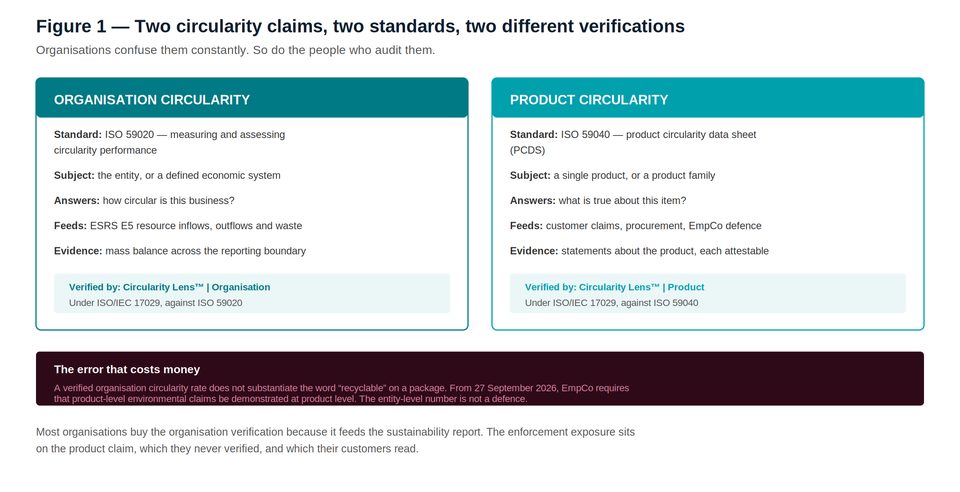
Figure 1 — Organisation circularity and product circularity are not the same claim, and not the same verification.
Term | Definition |
|---|---|
ISO 59020 | Circular economy — Measuring and assessing circularity performance. Specifies requirements for measuring circularity performance of an economic system within a defined boundary, using a mandatory set of circularity indicators supported by optional complementary indicators. |
ISO 59040 | Circular economy — Product circularity data sheet. Specifies the structure and content of a PCDS: a set of standardised statements about a product's circularity characteristics, made by the supplier and capable of being attested. |
Circularity performance | The extent to which resource inflows and outflows of a defined system are circular rather than linear. An entity-level or system-level property. |
Product circularity data sheet (PCDS) | A document accompanying a product, containing declarative statements about its circularity attributes — recycled content, recyclability, disassembly, hazardous substances — each of which is either true or false for that product. |
ISO/IEC 17029 | The accreditation standard governing validation and verification bodies. Both ISO 59020 and ISO 59040 claims are verified under it, by bodies accredited for the relevant scheme. |
The distinction is not academic. Consider a manufacturer whose ISO 59020 assessment produces a circularity performance figure of 62 per cent across its operations, verified, disclosed under ESRS E5, and cited approvingly by an analyst.
On a shelf in a supermarket, one of its packages says "recyclable".
The 62 per cent figure has no bearing whatsoever on whether that package is recyclable, in that market, through that collection infrastructure, at that scale. The two statements share a word and nothing else. Under EmpCo, from 27 September 2026, the second statement is a product-level environmental claim that must be demonstrated, and the entity-level verification is not a demonstration of it.
The circularity number that appears in your annual report and the circularity word that appears on your packaging are unconnected. Only one of them is read by a consumer, and only one of them attracts a four per cent penalty.
2. The claims taxonomy
Before deciding which verification to obtain, classify the claim. Each row below carries a different evidentiary burden, and the burden is not proportional to the confidence with which the claim is usually made.
Claim | What it asserts | Evidence required | Standard |
|---|---|---|---|
"Recycled content: 40%" | A measurable proportion of the product's mass derives from recycled feedstock | Mass balance or physical segregation, traceable through the supply chain, at product level | ISO 59040 (PCDS statement); chain of custody |
"Recyclable" | The product can, in practice and at scale, be collected, sorted and reprocessed in the market where it is sold | Evidence of collection and reprocessing infrastructure in that market, not merely material compatibility | ISO 59040; market-specific infrastructure evidence |
"Circular" | Undefined. A generic claim. | Under EmpCo, a generic environmental claim not demonstrable as recognised excellent environmental performance is prohibited from 27 September 2026 | None will save it. Withdraw or specify. |
"62% circularity performance" | The organisation's resource flows are 62% circular within a defined boundary | Measurement and assessment of the system against the standard's indicators, verified | ISO 59020 |
"Designed for disassembly" | The product can be taken apart with commonly available tools without destructive force | Design documentation, and a documented disassembly procedure | ISO 59040 (PCDS statement) |
"Closed loop" | Material recovered from the product returns to the same product system | Evidence of the actual return flow, not the theoretical possibility | ISO 59040; supply chain evidence |
THE RECYCLABILITY TRAP
"Recyclable" is the most common circularity claim and the least often substantiated correctly. It is not a property of a material. It is a property of a material in a market, given that market's collection and reprocessing infrastructure. A package that is technically recyclable and practically incinerated in the country where it is sold is not, for the purposes of a consumer protection authority, recyclable.
3. Why circularity is more exposed than carbon
Carbon claims are made by sustainability teams, calculated by specialists, and checked before publication because everybody understands that a tonne is a number and numbers can be wrong.
Circularity claims are made by product managers and packaging designers using words, and words feel safer than numbers. They are not.
Carbon | Circularity | |
|---|---|---|
Unit | Tonnes CO₂e. Universal, additive, comparable. | None universal. Percentages of different denominators. Not comparable across products. |
Who makes the claim | Sustainability function, with calculation behind it | Product and marketing functions, with a word behind it |
Where it appears | Report, then marketing | Packaging, immediately, at scale |
Audience | Analysts, investors, lenders | Consumers — and therefore consumer protection authorities |
Standard maturity | ISO 14064-1 since 2006; well-established verification market | ISO 59020 and ISO 59040 published 2024; verification market still forming |
Substantiation habit | Verified inventory is normal practice | Verification of product claims is rare |
Failure mode | The number is right, the narrative overstates it | The word is used with no calculation behind it at all |
The structural point
Carbon claims are usually right and often overstated.
Circularity claims are frequently unexamined.
EmpCo does not distinguish between them. It requires that any environmental claim made to a consumer be demonstrated, and it prohibits generic claims outright.
4. ESRS E5 and the reporting layer
For organisations still within CSRD scope, ESRS E5 requires disclosure on resource inflows, resource outflows and waste. The amended ESRS following the Omnibus I directive reduce prescribed datapoints substantially and shift weight onto materiality judgement and documentation — which makes the underlying measurement more consequential, not less, because there is now less prescription telling you what to measure and the same obligation to defend what you disclosed.
An ISO 59020 measurement gives the E5 disclosure a defensible basis: a defined system boundary, a documented indicator set, and a verified result. Without it, the E5 numbers are constructed for the report, from data that was not collected for the purpose, on a boundary chosen after the fact.
Then the assurance practitioner arrives under ISSA 5000 and asks how the boundary was determined.
The boundary problem
Circularity boundaries and greenhouse gas boundaries are rarely the same, and almost never deliberately so. A GHG inventory is typically consolidated on an operational control or equity share basis. A circularity assessment is typically performed on the physical sites where material flows can be measured. Joint ventures, tolling arrangements, contract manufacturing and leased assets fall differently under each.
The result is a single sustainability statement in which the entity's climate disclosure covers a different set of operations from its circularity disclosure, with no note explaining why. This is invisible to each verifier, who was engaged for one topic, and visible immediately to any practitioner reading both.
A QUESTION FOR YOUR NEXT AUDIT COMMITTEE MEETING
Does our circularity disclosure cover the same operations as our GHG inventory? If not, is the difference disclosed and explained? In most sustainability statements the answer to both questions is no, and nobody has ever been asked.
5. Six circularity claims to review before 27 September 2026
Any use of the word "circular" without a figure. A generic environmental claim. Under EmpCo, prohibited unless recognised excellent environmental performance can be demonstrated. Specify or withdraw.
"Recyclable" on any package sold into an EU market. Requires evidence of collection and reprocessing infrastructure in that specific market. Material compatibility is not sufficient.
Recycled content percentages. Require chain-of-custody evidence and a stated mass balance or segregation approach. A supplier declaration is not evidence unless the supplier can support it.
Self-created circularity labels or seals. Prohibited by EmpCo unless established under a certification scheme with third-party verification of compliance. A company's own "circular product" badge is exactly the artefact the prohibition targets.
Comparative claims — "more circular than". Require a stated basis of comparison, an identical functional unit, and evidence for both sides of the comparison.
Any product claim resting on the entity-level ISO 59020 figure. The entity-level measurement is not a product-level demonstration. This is the single most common substantiation error in circularity marketing, and it is the one this paper exists to prevent.
6. Where Circularity Lens™ fits
Circularity Lens™ exists in two variants because the standards do.
Circularity Lens™ | Organisation. Verification under ISO/IEC 17029 against ISO 59020. Examines the measurement and assessment of circularity performance within a defined boundary. Feeds ESRS E5 and the sustainability statement.
Circularity Lens™ | Product. Verification under ISO/IEC 17029 against ISO 59040. Examines the product circularity data sheet, statement by statement. Supports product-level claims made to customers and to consumers, and constitutes the evidence base for an EmpCo defence.
An organisation making both entity-level disclosures and product-level claims needs both, and they should be performed against a single agreed boundary and site list. Speeki is an accredited certification and assurance body and does not provide consulting services; details of its accreditations and their scope are published at speeki.com.
The independence point has particular force here. EmpCo prohibits sustainability labels not established under a certification scheme with third-party verification of compliance. A verification of a circularity claim performed by the party that designed the claim is not third-party verification, and a consumer authority contemplating a four per cent penalty will examine the relationship before the methodology.
Questions this paper answers
What is the difference between ISO 59020 and ISO 59040?
ISO 59020 specifies requirements for measuring and assessing the circularity performance of an economic system within a defined boundary — for most companies, the organisation. It supports entity-level disclosure including ESRS E5. ISO 59040 specifies the product circularity data sheet: a structured set of attestable statements about a specific product's circularity characteristics. It supports product-level claims. A verification against one does not substantiate a claim under the other.
Does an organisation-level circularity verification substantiate a product claim?
No. An ISO 59020 verification examines circularity performance across a defined system boundary. It says nothing about whether any individual product is recyclable, contains a stated proportion of recycled content, or can be disassembled. From 27 September 2026, EmpCo requires product-level environmental claims to be demonstrated, and the entity-level figure is not a demonstration.
Can a product still be labelled "recyclable" in the EU?
Only where the claim can be demonstrated. Recyclability is not a property of a material; it is a property of a material in a market, determined by that market's collection and reprocessing infrastructure. A package that is technically recyclable but practically incinerated in the country of sale is unlikely to withstand examination by a consumer protection authority applying EmpCo from 27 September 2026.
Are self-created circularity labels permitted?
No, from 27 September 2026. Directive (EU) 2024/825 prohibits sustainability labels that are not established under a certification scheme, or not established by public authorities. A company's own circularity badge or seal, however well-intentioned, falls within the prohibition unless it rests on a certification scheme with third-party verification of compliance.
Why are circularity claims more exposed than carbon claims?
Because they are made in words rather than numbers, by product and marketing functions rather than sustainability specialists, on packaging read by consumers rather than in reports read by analysts, and because the verification market for ISO 59020 and ISO 59040 — both published in 2024 — is still forming. Carbon claims are usually right and sometimes overstated. Circularity claims are frequently unexamined.
How does circularity measurement relate to ESRS E5?
ESRS E5 requires disclosure on resource inflows, resource outflows and waste. An ISO 59020 measurement provides a defined system boundary, a documented indicator set and a verified result to underpin those disclosures. The amended ESRS following the Omnibus I directive reduce prescribed datapoints and shift weight onto materiality judgement and documentation, which increases rather than decreases the importance of a defensible underlying measurement.
Should circularity and greenhouse gas disclosures use the same boundary?
They should, and they usually do not. GHG inventories are consolidated on an operational control or equity share basis; circularity assessments are typically performed on physical sites where material flows can be measured. Joint ventures, tolling arrangements, contract manufacturing and leased assets fall differently under each. The resulting inconsistency within a single sustainability statement is invisible to each verifier engaged for one topic, and immediately visible to an assurance practitioner reading both.
References and sources
ISO 59020:2024, Circular economy — Measuring and assessing circularity performance.
ISO 59040:2024, Circular economy — Product circularity data sheet.
ISO/IEC 17029:2019, Conformity assessment — General principles and requirements for validation and verification bodies.
Directive (EU) 2024/825, Empowering Consumers for the Green Transition (EmpCo). Transposition deadline 27 March 2026; applicable from 27 September 2026. Prohibits generic environmental claims and sustainability labels not established under a certification scheme, with penalties reaching 4% of annual turnover.
European Commission announcement of intention to withdraw the Green Claims Directive proposal, 20 June 2025.
European Sustainability Reporting Standard E5, Resource use and circular economy, as amended following Directive (EU) 2026/470.
Directive (EU) 2026/470 (the Omnibus I directive), in force 18 March 2026 — reducing prescribed ESRS datapoints and increasing the weight placed on materiality judgement and documentation.
Speeki, Verified, Then Assured (Whitepaper Series 4, Paper 15), July 2026.
About Speeki
Speeki is an accredited ESG assurance and certification body operating in more than 100 countries. Speeki provides management system certification, verification and validation, and sustainability assurance. Speeki does not provide consulting services. Its independence is structural.
For current details of Speeki's accreditations and their scope, please refer to speeki.com.
© 2026 Speeki. This paper is provided for general information and does not constitute legal, accounting or assurance advice.