

Quick Read
A large organization's environmental disclosures—greenhouse gas inventory (ISO 14064-1), circularity performance (ISO 59020), and biodiversity impact (GRI 101)—are typically verified separately by different accredited providers on different boundaries and cycles, each producing correct statements within their individual scope. The failures occur not within any single verification but at the seams between them: different consolidation approaches, site lists, value chain boundaries, and reporting periods create partially overlapping and unreconciled populations across the three disclosures, with no explanation of the differences because no single engagement was designed to notice them. Bundling environmental verification under a unified framework like ISSA 5000 functions as a control mechanism to reconcile these boundary decisions and ensure consistency across the organization's environmental claims.
IN BRIEF
Carbon, circularity and nature verifications are all performed under ISO/IEC 17029 by accredited validation and verification bodies, against ISO 14064-1 and ISO 14067, ISO 59020 and ISO 59040, and GRI 101 / ESRS E4 / TNFD respectively. Nature additionally now has a management system standard, ISO 17298:2025.
All three depend on the same four foundational decisions: the reporting boundary, the consolidation approach, the site list, and the reporting period.
When procured separately, each provider sets those four decisions independently and within its own scope. None is engaged to reconcile them, and none is accountable for the inconsistencies that result.
An ISSA 5000 assurance practitioner examining the sustainability statement sees all three disclosures together, and the inconsistencies between them are visible immediately.
The environmental assurance bundle is not a procurement discount. It is a control over the seams, and the seams are where the findings are.
Executive summary
A large group publishes a sustainability statement containing three environmental disclosures. Its greenhouse gas inventory, verified under ISO 14064-1, is consolidated on an operational control basis. Its circularity performance, measured and verified under ISO 59020, covers the sites at which material flows can be metered. Its biodiversity disclosure, prepared under GRI 101, covers the sites its ecological consultants identified as having significant impacts.
Three verifications. Three accredited providers. Three clean statements. Three different sets of operations.
Nobody did anything wrong. Each verifier examined the claim it was engaged to examine, on the boundary the company presented, against the standard that applies. Each was correct within its scope. The company now has a sustainability statement in which its climate disclosure, its circularity disclosure and its nature disclosure describe partially overlapping and unreconciled populations, with no note explaining the differences, because no one was engaged to notice them.
THE DEFINITION OF A SEAM
A seam is a decision that two engagements both depend upon and neither owns. The boundary. The consolidation approach. The site list. The period. Each verifier treats them as given. The company treats them as technical. The assurance practitioner treats them as evidence.
This paper sets out the four seams, how each one fails, what an ISSA 5000 practitioner sees when they open the statement, and why bundling environmental verification is a control rather than a commercial arrangement.
1. Three verifications, one evidence base
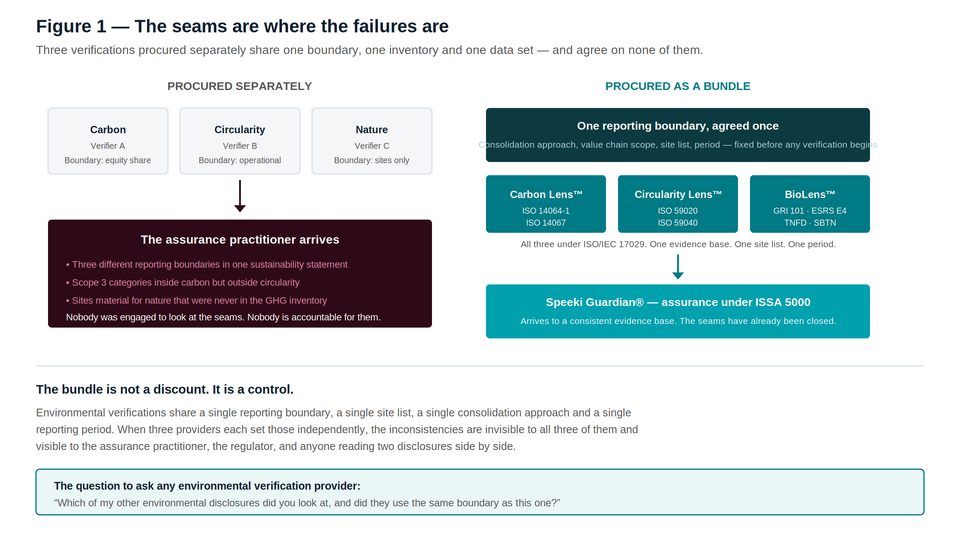
Figure 1 — Three engagements procured separately share four decisions and agree on none of them.
The Speeki Lens Suite™ comprises three verification disciplines, all performed under ISO/IEC 17029, all examining environmental claims, all drawing on the same underlying facts about the organisation.
Lens | Standards | What it needs from the organisation |
|---|---|---|
ISO 14064-1 (organisation), ISO 14067 (product), ISO 14068-1 (neutrality) | Consolidation approach, entity list, activity data by site, emission factors, reporting period | |
ISO 59020 (organisation), ISO 59040 (product circularity data sheet) | System boundary, material flows by site, mass balance, reporting period | |
GRI 101, ESRS E4, TNFD, SBTN; ISO 17298 for the system | Site list with location and size, determination of significant impacts, value chain scope, baseline, assessment period |
Read the third column. Every one of them requires a site list, a boundary, a scope decision about the value chain, and a period. These are not three data requests. They are one data request, asked three times, of three different people, who answer from three different systems.
The three verifiers never meet. The three disclosures appear on facing pages.
2. The four seams
Seam one — The consolidation approach
A GHG inventory under ISO 14064-1 requires a stated consolidation approach: operational control, financial control, or equity share. A circularity assessment under ISO 59020 requires a defined system boundary, and in practice this is drawn around the physical sites where material flows can be measured. A biodiversity assessment covers sites where the organisation's activities have significant impacts, whether or not it controls them.
Joint ventures, tolling arrangements, contract manufacturing, leased assets and franchised operations fall differently under each. A 40 per cent joint venture may be outside the GHG inventory on an operational control basis, inside the circularity assessment because the material flows through it, and inside the biodiversity disclosure because it sits on a wetland.
Each treatment is defensible. Together, in one statement, they are unexplained.
Seam two — The site list
Every environmental disclosure rests on a list of places. Three providers will each construct one, from three sources: the emissions inventory system, the operations material flow records, and the ecological consultant's assessment scope.
The test is simple and almost nobody applies it. Take the biodiversity site list and the GHG site list and reconcile them. A site material for nature but absent from the emissions inventory is either a site with no emissions — possible, but worth explaining — or an omission from the inventory. A site in the emissions inventory but absent from the nature assessment is either a site with no biodiversity impact — an assertion, not a fact — or an unassessed impact.
THE RECONCILIATION THAT PRODUCES FINDINGS
Biodiversity site list, GHG site list, asset register, insurance schedule. Four documents that should describe the same organisation. In most large groups they describe four different organisations, and the differences have never been examined by anyone.
Seam three — The value chain scope
GRI 101 requires biodiversity impacts arising from products and services in the supply chain, including suppliers beyond the first tier. ISO 14064-1 permits, and ESRS E1 requires, Scope 3 categories to be included on a documented basis. ISO 59020 addresses resource inflows, which by definition originate outside the organisation.
All three reach into the value chain. None of them reaches the same distance. And following the Omnibus I directive, protected undertakings below 1,000 employees have a legal right to refuse information requests exceeding the voluntary SME standard, which means the reach of all three is now constrained by the same legal boundary — a boundary that each provider will discover independently, at different points, and describe differently.
Seam four — The period
Carbon inventories cover the financial year. Circularity measurement often covers a production year. Ecological assessments are seasonal: a wetland surveyed in February and a wetland surveyed in July are, from a species perspective, different wetlands.
The sustainability statement presents all three as describing the same year.
3. What the assurance practitioner sees
Under ISSA 5000, effective for periods beginning on or after 15 December 2026, the practitioner examines the sustainability information as a whole. They read the climate disclosure, the circularity disclosure and the nature disclosure in a single document, and they are required to consider risks of material misstatement across it.
The seams are the first thing visible, because they are the only thing in the statement that can be tested by comparison rather than by evidence.
What the practitioner does | What it reveals |
|---|---|
Compares the site lists across the three disclosures | Sites present in one and absent from another, with no stated reason |
Compares the consolidation approach statements | Three different bases, or — more commonly — two disclosures with no stated basis at all |
Traces the value chain scope of each | One disclosure reaching tier three, another stopping at tier one, both described as covering "the value chain" |
Reads the periods | An ecological survey conducted in a single season, presented as an annual assessment |
Compares production or throughput figures used as denominators | Different denominators in the intensity metrics of different disclosures |
Considers whether the entity's own materiality determination identified these inconsistencies | It did not. Nobody was looking at the seams. |
Why this is worse than an error inside an engagement
An error inside a verification is found by the verifier and corrected before the statement is published.
An inconsistency between verifications is found by nobody, because no verifier's scope includes the others.
It is then found by the assurance practitioner, in the weeks before publication, when nothing can be changed except the disclosure.
Or it is found afterwards, by a regulator, a competitor, or an NGO reading two of your disclosures side by side.
4. The bundle as a control
The environmental assurance bundle combines carbon, circularity and nature verification into a single engagement architecture with one governing set of foundational decisions. The commercial argument for it is real and secondary. The control argument is the reason it exists.
The four seam decisions are made once, before any verification begins. Consolidation approach, site list, value chain scope, and reporting period are agreed, documented and applied across all three disciplines. Departures are deliberate, stated, and explained in the disclosure.
One evidence base serves three engagements. The site list assembled for the GHG inventory is the site list examined for nature. Reconciliation happens during the engagement rather than after publication.
Inconsistencies become findings during the period, not disclosures after it. A site material for nature and absent from the emissions inventory is identified while there is time to include it.
The value chain boundary is determined once, against the same legal constraint. The Omnibus I value chain cap applies identically to all three disciplines. Determining once which counterparties are protected undertakings prevents three different answers.
The assurance practitioner arrives to a consistent statement. The comparisons that would have produced findings have already been made, and where differences remain they are explained in the disclosure rather than discovered in it.
THE PROCUREMENT QUESTION THAT REVEALS WHETHER YOU HAVE A SEAM PROBLEM
Ask each of your environmental verification providers: which of my other environmental disclosures did you look at, and did they use the same boundary as this one? Three providers will give you three versions of the same answer, which is that it was not in their scope.
5. What a bundle does not do
Two claims should not be made for it, and this paper will not make them.
It is not assurance. Verification under ISO/IEC 17029 examines a claim. Assurance under ISSA 5000 examines a disclosure. A bundle of three verifications, however consistent, does not produce an assurance conclusion on the sustainability statement, and does not discharge the CSRD limited assurance requirement.
It does not reduce the number of standards. ISO 14064-1, ISO 59020 and GRI 101 remain three standards with three methodologies and three sets of competence requirements. Bundling coordinates the engagements; it does not merge the disciplines, and a provider claiming otherwise is describing something that would not survive accreditation scrutiny.
What it does is make one party accountable for the space between the engagements. That party is currently nobody.
6. Where the Speeki Lens Suite™ fits
The Lens Suite comprises Speeki Carbon Lens®, Speeki Circularity Lens™ in organisation and product variants, and Speeki BioLens™ — all performed under ISO/IEC 17029 by Speeki as an accredited body. Speeki Guardian® provides sustainability assurance under ISSA 5000 over the disclosure that contains them.
The architecture is deliberate. One provider across the three verification disciplines makes the seams somebody's responsibility. A separate engagement, under a separate standard, assures the report — because the verification of a claim and the assurance of a disclosure about that claim are different examinations, and a provider that performed the first is not thereby excused from performing the second properly.
Speeki is an accredited certification and assurance body and does not provide consulting services; details of its accreditations and their scope are published at speeki.com.
Buy three verifications and you have bought three answers. Buy the bundle and you have bought the one thing none of them contained: an account of how they fit together.
Questions this paper answers
What is the environmental assurance bundle?
It is the combination of carbon, circularity and nature verification into a single engagement architecture in which the four foundational decisions those disciplines share — the reporting boundary and consolidation approach, the site list, the value chain scope, and the reporting period — are agreed once and applied consistently, rather than being set independently by three providers within three separate scopes.
Why do separately procured environmental verifications create problems?
Because each verification is correct within its own scope and none is accountable for consistency with the others. A joint venture may be outside the GHG inventory on an operational control basis, inside the circularity assessment because material flows through it, and inside the biodiversity disclosure because of its location. Each treatment is defensible. Together, in one sustainability statement, they are unexplained — and an ISSA 5000 practitioner reading all three disclosures sees the inconsistency immediately.
What are the four seams?
The consolidation approach, which differs between a GHG inventory under ISO 14064-1, a circularity system boundary under ISO 59020, and a biodiversity site scope under GRI 101. The site list, which three providers will construct from three different source systems. The value chain scope, where all three disciplines reach into the supply chain but none reaches the same distance. And the reporting period, where ecological assessments are seasonal and carbon inventories are annual, yet both are presented as describing the same year.
How does the Omnibus I value chain cap affect environmental verification?
The Omnibus I directive gives undertakings in the value chain with fewer than 1,000 employees a legal right to refuse information requests exceeding the voluntary SME standard. That constraint applies identically to carbon, circularity and nature data gathering. Where three providers each discover the boundary independently, at different points in their engagements, they will describe it differently in three disclosures. Determining once which counterparties are protected undertakings prevents three inconsistent answers.
Does a bundle of verifications satisfy the CSRD assurance requirement?
No. Verification under ISO/IEC 17029 examines a specific claim against a measurement standard. Assurance under ISSA 5000 examines whether reported sustainability information is materially misstated. The CSRD requires limited assurance over the sustainability statement, and no combination of verification statements discharges that obligation. Verification and assurance are complementary examinations of different subject matter.
What single question exposes a seam problem?
Ask each environmental verification provider: which of my other environmental disclosures did you look at, and did they use the same boundary as this one? Each will answer, correctly, that it was not within their scope. That answer is the finding.
Which reconciliation produces the most findings?
Comparing four documents that should describe the same organisation: the biodiversity site list, the greenhouse gas site list, the asset register, and the insurance schedule. In most large groups they describe four different organisations, and the differences have never been examined by anyone, because no engagement's scope required it.
References and sources
ISO/IEC 17029:2019, Conformity assessment — General principles and requirements for validation and verification bodies.
ISO 14064-1:2018, Greenhouse gases — Part 1: Specification with guidance at the organization level; ISO 14067:2018, Carbon footprint of products; ISO 14068-1:2023, Carbon neutrality.
ISO 59020:2024, Circular economy — Measuring and assessing circularity performance; ISO 59040:2024, Circular economy — Product circularity data sheet.
GRI 101: Biodiversity 2024, effective for reports published on or after 1 January 2026; ESRS E4, Biodiversity and ecosystems; Taskforce on Nature-related Financial Disclosures, Recommendations, September 2023.
IAASB, ISSA 5000, General Requirements for Sustainability Assurance Engagements; effective for periods beginning on or after 15 December 2026.
Directive (EU) 2026/470 (the Omnibus I directive), in force 18 March 2026 — introducing the value chain cap for protected undertakings below 1,000 employees.
Speeki, Verified, Then Assured (Series 4, Paper 15); The Circularity Claim You Cannot Substantiate (Series 4, Paper 16); The Nature Disclosure Nobody Can Assure (Series 4, Paper 17), July 2026.
About Speeki
Speeki is an accredited ESG assurance and certification body operating in more than 100 countries. Speeki provides management system certification, verification and validation, and sustainability assurance. Speeki does not provide consulting services. Its independence is structural.
For current details of Speeki's accreditations and their scope, please refer to speeki.com.
© 2026 Speeki. This paper is provided for general information and does not constitute legal, accounting or assurance advice.