

Quick Read
An independent pre-submission ESG ratings review has value only if the reviewer can recommend withdrawal of assertions without financial consequence—a standard that excludes rating agencies (now regulated against advising rated companies) and consultants (who profit from score improvement). Speeki's whitepaper defines the narrow structural requirements for such reviews and identifies four ways the engagement degrades into coaching if those boundaries erode.
IN BRIEF
Independent pre-submission review examines whether each assertion in an ESG ratings submission is supported by evidence the company holds, whether the response is complete, and whether it is consistent with the company's other public disclosures.
It is not advice on improving the score, not a prediction of the score, not a negotiation with the rating agency, and not an assurance opinion under ISSA 5000.
Regulation (EU) 2024/3005, applicable from 2 July 2026, imposes independence and conflict-of-interest requirements on ESG rating providers in respect of activities that could compromise the independence of their rating activities.
A consultant who prepared a submission cannot independently examine it, is subject to no accreditation regime or independence standard, and has no obligation — and no commercial incentive — to reach an adverse finding.
The value of the engagement rests entirely on the examiner's structural capacity to conclude that a sentence should be deleted, and on that conclusion costing the examiner nothing.
Executive summary
There is a species of professional engagement whose entire value lies in the possibility of an unwelcome answer. A statutory audit is worth something because the auditor can qualify the opinion. A certification audit is worth something because the certification body can withhold the certificate. A medical second opinion is worth something because the second doctor can disagree with the first.
Remove the possibility of the unwelcome answer and the engagement does not become less rigorous. It becomes a different thing entirely — a service, sold to a buyer, whose satisfaction determines whether it is bought again.
ESG ratings submissions have never been subject to an engagement of the first kind. They have been subject, extensively, to engagements of the second kind: gap analyses, readiness assessments and score-improvement programmes, delivered by firms whose success is measured by the score going up, and who therefore have no reason to look for the one finding that would make it go down.
THE DEFINING CONSTRAINT
An examination of a ratings submission is worth commissioning only if the examiner is capable of concluding that an assertion should be withdrawn, and if reaching that conclusion costs them nothing. Every design decision in this paper follows from that sentence.
Regulation (EU) 2024/3005, applicable from 2 July 2026, has made this urgent by foreclosing the most obvious provider. This paper sets out who may perform the review, what it examines, what it produces, and the four ways it degrades into coaching.
1. Three candidates, two exclusions
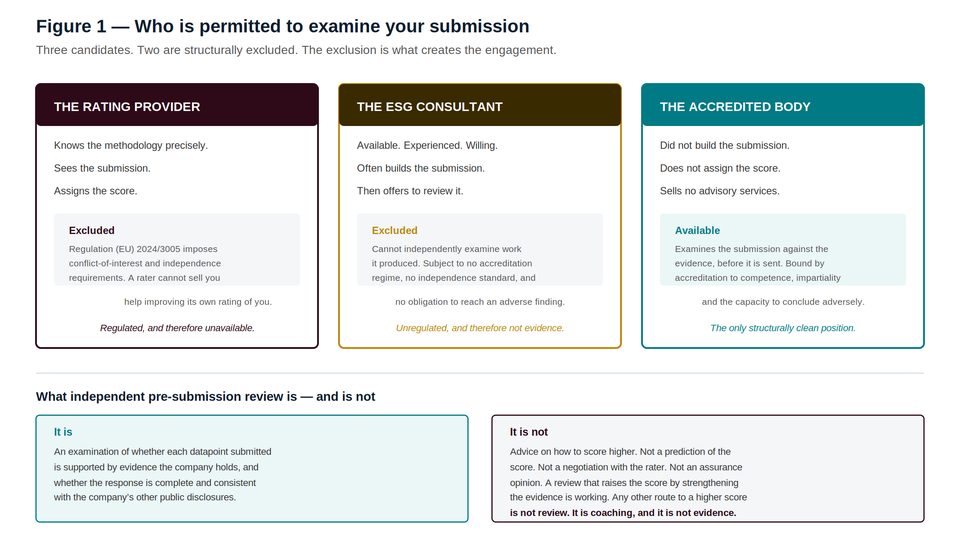
Figure 1 — The rating provider is now regulated out. The consultant is structurally out. What remains is narrow.
The rating provider — regulated out
The rating provider knows the methodology precisely, sees the submission, and assigns the score. It is, on the face of it, the ideal reviewer.
Regulation (EU) 2024/3005 imposes independence and conflict-of-interest requirements on ESG rating providers, addressed to activities that could compromise the independence of their rating activities. The clear implication is that a provider may not sell a rated company assistance in improving the rating that provider assigns. This is the same structural judgement that financial reporting reached after Enron and codified in section 201 of the Sarbanes-Oxley Act: the party forming the opinion may not also be paid to shape what the opinion is formed from.
The reform is correct. Its effect on the rated company is to remove an option that was never appropriate and was widely wished for.
The ESG consultant — structurally out
The consultant is available, experienced and willing. In a great many companies the consultant also built the submission, and now offers to review it.
Three objections, of which only the third is decisive.
Self-review. A party cannot independently examine work it produced. This is not a matter of integrity; it is a matter of what the word independent means. The financial reporting profession concluded this after a decade of demonstrations.
No accreditation. ESG consultancy is subject to no accreditation regime, no competence standard enforced by a third party, and no independence standard. There is no body that can withdraw a consultant's ability to practise following a failure.
No capacity for an adverse finding. The consultant is engaged, explicitly or implicitly, to improve the score. The finding that an assertion should be deleted lowers the score. A party whose renewal depends on the score rising is not structurally capable of producing the single most valuable output of the engagement.
You cannot buy an examination from somebody whose fee depends on the examination coming out well.
The accredited body — what remains
A body accredited under an appropriate conformity assessment standard did not build the submission, does not assign the score, and sells no advisory services. It is bound by accreditation to competence requirements, impartiality requirements, structured evidence requirements, and to the capacity — indeed the obligation — to reach an adverse conclusion where the evidence supports one.
That is not a claim about virtue. It is a description of an incentive structure. An accredited body that concludes an assertion is unsupported loses nothing, because its accreditation, not its client's satisfaction, is the asset it is protecting.
2. What the review examines
The review has four objects, and they are examined in this order because each depends on the one before it.
Object | The question | What a finding looks like |
|---|---|---|
The assertions | For each response asserting a practice, process, outcome or frequency: does the company hold evidence that it is true? | "The submission states that the board reviews climate risk quarterly. Board minutes evidence two discussions in the period." |
The evidence owners | Can a named individual produce the evidence within one week, without escalation? | "No individual could be identified as the owner of the supply chain human rights due diligence assertion." |
Completeness | Are there practices the company operates and has not disclosed, which the methodology would credit? | "The company operates a supplier audit programme with consequences for non-compliance, disclosed nowhere, worth points under three indicators." |
Consistency | Does the submission agree with the company's other public disclosures, including any statement subject to assurance under ISSA 5000? | "Scope 3 emissions in the submission are stated on a different boundary from the assured sustainability statement. Neither document discloses the difference." |
THE ORDER MATTERS
Examining completeness before examining the assertions produces a list of ways to score higher. Examining the assertions first produces a list of statements the company cannot support. Only one of those lists protects the board, and it is not the popular one.
3. What the review produces
Not a score prediction. Not a benchmark against peers. Not a roadmap.
A classification of every assertion. Supported by evidence, supported by evidence not currently retained, or unsupported. The third class is the output that matters.
A withdrawal list. Assertions that should not appear in the next submission until the underlying evidence exists. The reviewer states this; the company decides.
A disclosure gap list. Practices the company operates, can evidence, and has not disclosed. This is the list that raises the score, and it raises it legitimately, because everything on it is true and provable.
A reconciliation to the assured statement. Every discrepancy between the submission and the sustainability statement, itemised, with the two figures and the two definitions.
An evidence ownership map. Which assertions have named owners, which do not, and which owners could not produce evidence within the week.
What the report will say that nobody wants to read
That the company asserted, in a document relied upon by index providers and lenders, a practice it cannot evidence.
That no individual owns that assertion.
That the assertion has appeared in three consecutive submissions.
And that the correct action is to remove it, accept a lower score, build the control, and reinstate it truthfully in two years.
4. Four ways the review degrades into coaching
Each of these has been observed. Each is a failure of the engagement design rather than of the individuals performing it, and each should be treated as a red flag by the audit committee commissioning the work.
The scope is defined by the score. If the engagement letter refers to score improvement, target quartiles, or peer benchmarking, the review has been converted into a service before it has begun. The scope must be defined by the evidence.
The reviewer drafts the responses. A reviewer who suggests wording is producing the submission. At the next cycle they will be reviewing their own work, and the exclusion in section 1 applies to them.
Completeness is examined before assertions. Beginning with what the company failed to claim, rather than what it claimed and cannot support, produces a pleasant report and leaves the exposure untouched.
The report is addressed to investor relations. The findings concern unsupported public statements, unassigned accountability and inconsistency with an assured disclosure. Those are audit committee matters. A review whose findings terminate with the team that prepared the submission has no consequence.
THE COMMISSIONING TEST
Ask the prospective reviewer one question: in the last twelve engagements, how many times did you recommend that a client remove an assertion from its submission, and what did that do to the client's score? A reviewer who has never recommended a withdrawal has never performed this engagement.
5. How the review sits alongside assurance and certification
Independent pre-submission review is not assurance. It is important to say this plainly, because the market has a habit of accepting adjacent words as equivalent.
Pre-submission review | Assurance under ISSA 5000 | |
|---|---|---|
Subject matter | The ratings submission — a private document sent to a rating provider | Reported sustainability information — a published statement |
Governing standard | No dedicated standard exists. Conducted under the discipline of an accredited body's conformity assessment obligations. | ISSA 5000, effective for periods beginning on or after 15 December 2026 |
Output | A classification of assertions, a withdrawal list, a reconciliation, an evidence ownership map | A limited or reasonable assurance conclusion |
Discharges | No regulatory obligation. There is none to discharge. | The CSRD limited assurance requirement for in-scope entities |
Why obtain it | Because the submission is the least controlled consequential document the company produces | Because the law requires it, and because the report is public |
The candour of the fourth row is deliberate. Pre-submission review discharges no legal obligation, because no legal obligation exists. That is the entire subject of Paper 19: the output is regulated and the input is not. A company obtains this review for the same reason it obtained internal audit before anybody required it — because an unexamined process that determines its cost of capital is a governance failure regardless of whether a regulator has yet noticed.
The engagements worth having are usually the ones nobody has mandated yet. By the time they are mandated, the companies that waited have already discovered why.
6. Where RatingsReady™ fits
Speeki RatingsReady™ is independent pre-submission review, performed by Speeki as an accredited body. It examines the assertions, the evidence owners, the completeness of the submission, and its consistency with the company's other public disclosures. It produces a classification, a withdrawal list, a disclosure gap list, a reconciliation and an evidence ownership map, and it reports to the audit committee.
It does not draft responses. It does not advise on scoring. It does not benchmark against peers. It does not predict the score, and it will not tell you what your score would have been.
Speeki is an accredited certification and assurance body and does not provide consulting services; details of its accreditations and their scope are published at speeki.com. That fact is not a credential appended to this paper. It is the argument of the paper. An examination whose examiner has something to sell you afterwards is not an examination.
THE ONLY CLAIM THIS PAPER MAKES FOR THE ENGAGEMENT
It is capable of telling you that a sentence in your submission is not true, and nothing bad happens to the person who tells you.
Questions this paper answers
What is independent pre-submission review of an ESG ratings submission?
An examination, before the submission is sent, of whether each assertion it contains is supported by evidence the company holds, whether a named individual owns that evidence, whether the submission omits practices the company operates and could evidence, and whether it is consistent with the company's other public disclosures including any statement subject to assurance. It produces a classification of assertions, a withdrawal list, a disclosure gap list, a reconciliation and an evidence ownership map.
Can an ESG rating agency review my submission before I send it?
Not in a way that constitutes independent review. Regulation (EU) 2024/3005, applicable from 2 July 2026, imposes independence and conflict-of-interest requirements on ESG rating providers in respect of activities that could compromise the independence of their rating activities. A provider may not sell a rated company assistance in improving the rating that provider assigns — the same structural judgement financial reporting reached after Enron and codified in section 201 of the Sarbanes-Oxley Act.
Why can't the consultant who prepared the submission review it?
Three reasons. A party cannot independently examine work it produced. ESG consultancy is subject to no accreditation regime, no externally enforced competence standard and no independence standard. And a party engaged to improve the score is not structurally capable of producing the engagement's most valuable output — the finding that an assertion should be deleted, which lowers the score.
What is the most valuable output of the review?
The withdrawal list: the assertions that should not appear in the next submission until the underlying evidence exists. It lowers the score. It is also the only output that reduces the company's exposure, because an assertion the company cannot support has already been relied upon by index providers, asset managers and lenders, and the first party to test it will not be the rating agency.
Is pre-submission review the same as assurance under ISSA 5000?
No. Assurance under ISSA 5000 examines published sustainability information and produces a limited or reasonable assurance conclusion, discharging the CSRD limited assurance requirement for in-scope entities. Pre-submission review examines a private document sent to a rating provider, produces a classification of assertions rather than a conclusion, and discharges no legal obligation — because none exists. That absence is precisely the reason to obtain it.
How can a company tell whether a review has degraded into coaching?
Four signals. The engagement letter refers to score improvement, target quartiles or peer benchmarking rather than to evidence. The reviewer drafts or suggests response wording, and will therefore be reviewing its own work next cycle. The reviewer examines completeness before examining the assertions, producing a pleasant report that leaves the exposure untouched. And the report is addressed to investor relations rather than to the audit committee, so the findings terminate with the team that prepared the submission.
What single question should be asked of a prospective reviewer?
In your last twelve engagements, how many times did you recommend that a client remove an assertion from its submission, and what did that do to the client's score? A reviewer who has never recommended a withdrawal has never performed this engagement — they have performed a different one, competently, under the same name.
References and sources
Regulation (EU) 2024/3005 on the transparency and integrity of ESG rating activities. Date of application 2 July 2026. Imposes authorisation, methodology transparency, governance, independence and conflict-of-interest requirements on ESG rating providers operating in the EU.
ESMA, ESG Rating Providers — authorisation and supervision. Notification deadline 2 August 2026; applications for authorisation or recognition by 2 November 2026.
Sarbanes-Oxley Act of 2002, section 201 — prohibited non-audit services. The statutory precedent for excluding the party forming an opinion from also shaping what the opinion is formed from.
ISO/IEC 17021-1:2015 and ISO/IEC 17029:2019 — the accreditation standards governing certification bodies and validation and verification bodies respectively, including their impartiality and competence requirements.
IAASB, ISSA 5000, General Requirements for Sustainability Assurance Engagements; effective for periods beginning on or after 15 December 2026.
Speeki, The Unaudited Submission (Series 5, Paper 19) and Where the Points Are Lost (Series 5, Paper 20), July 2026.
About Speeki
Speeki is an accredited ESG assurance and certification body operating in more than 100 countries. Speeki provides management system certification, verification and validation, and sustainability assurance. Speeki does not provide consulting services. Its independence is structural.
For current details of Speeki's accreditations and their scope, please refer to speeki.com.
© 2026 Speeki. This paper is provided for general information and does not constitute legal, accounting or assurance advice.