

Quick Read
Companies typically score poorly on ESG ratings not because their performance is weak, but because they fail to evidence existing practices or describe them in language the methodology recognizes—a problem that Regulation 2024/3005 now makes diagnosable through disclosed methodologies. Point loss falls into four distinct categories, with the largest being entirely absent disclosure of practices that already exist, recoverable at minimal cost in the next reporting cycle. The paper distinguishes between performance gaps and disclosure gaps, showing that raising scores through performance improvements alone often misses the easier opportunity to recover points through better evidence and communication of current practices.
IN BRIEF
Point loss in an ESG rating falls into four categories: disclosure absent, disclosure present but unlocatable, disclosure present but evidence absent, and genuine performance gap.
The first two categories are typically the largest, and both are recoverable without changing the company's performance at all.
The third category — an assertion the company cannot support — is the only one where raising the score increases the company's exposure rather than reducing it.
Regulation (EU) 2024/3005, applicable from 2 July 2026, requires ESG rating providers to disclose their methodologies, models and key rating assumptions, which makes point loss diagnosable for the first time.
Rating agencies score the submission. They do not verify it. An assertion entered into a submission is a public statement about the company that no independent party has examined.
Executive summary
When a company receives a poor ESG rating, the internal conversation follows a predictable path. The board asks why the score is low. The sustainability team explains that the methodology is opaque, the weightings arbitrary, and the peer comparison unfair. Somebody proposes engaging a consultant to improve the score. The consultant produces a gap analysis. The score rises modestly. Nobody asks what changed.
The premise of that conversation is that the score reflects performance, and that improving the score therefore requires improving performance. The premise is largely false, and the falseness cuts in an uncomfortable direction: most companies score below their actual performance, because they cannot evidence what they already do.
THE FOUR CATEGORIES
Disclosure absent — you do it, you never said so. Disclosure present but unlocatable — you said so, in the wrong place or the wrong words. Disclosure present but evidence absent — you said so, and cannot prove it. Genuine performance gap — you do not do it. Only the fourth requires doing anything differently. Only the third is dangerous.
Regulation (EU) 2024/3005, which applied from 2 July 2026, requires rating providers to disclose their methodologies, models and key assumptions. For the first time, point loss can be diagnosed rather than guessed at. This paper sets out how.
1. The anatomy of point loss
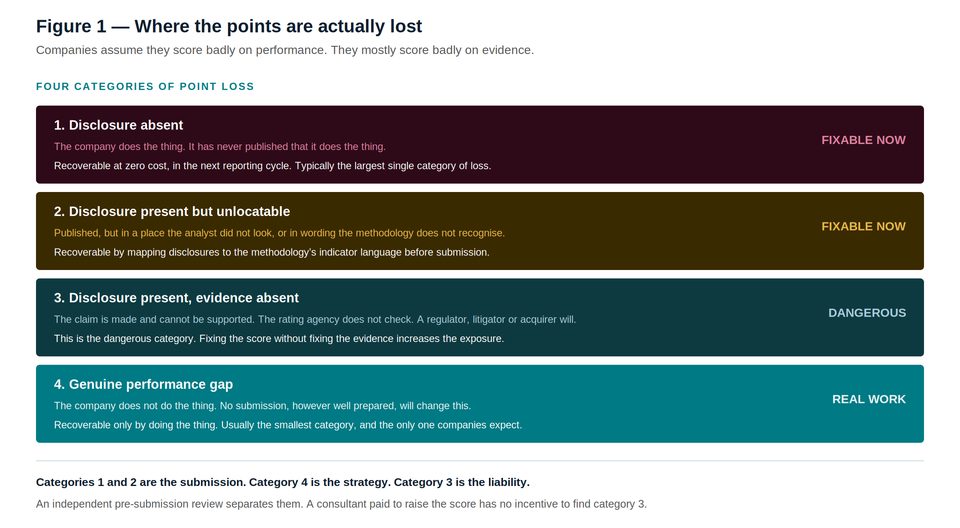
Figure 1 — Four categories of point loss. Companies expect the fourth and suffer from the first three.
Category 1 — Disclosure absent
The company operates a supplier code of conduct, audits against it, and terminates suppliers who fail. It has never published any of this. The methodology awards points for disclosure of a supplier code, disclosure of an audit programme, and disclosure of consequences for non-compliance. The company scores zero on all three.
This is the largest single category of point loss in most submissions, and it is entirely recoverable in the next reporting cycle at essentially no cost. What it requires is somebody who has read the methodology and the company's disclosures side by side, and has enumerated the practices that exist and are unpublished.
The reason this work is rarely done is that it is nobody's job. The sustainability report is written to satisfy a reporting framework, not a rating methodology. The submission is completed by answering the questions asked, not by asking what the company might have said.
Category 2 — Disclosure present but unlocatable
The practice is disclosed. It is disclosed in the annual report rather than the sustainability report, or in the code of conduct rather than either, or on a subsidiary's website, or in language that does not match the methodology's indicator.
A methodology may ask whether the company has a policy on water stewardship. The company has an integrated environmental policy that addresses water abstraction in a paragraph. An analyst applying a structured methodology, at scale, across thousands of issuers, does not find the paragraph.
Rating analysts are not looking for the truth about your company. They are looking for the answer to a specific question, in a place they can find it, in words they recognise. That is not a criticism of them. It is a description of what scaled assessment requires.
The remedy is a disclosure map: every methodology indicator, mapped to the specific document, section and wording in the company's public record that answers it. Where the map has a gap, either the disclosure is missing — category one — or it exists and cannot be found.
Category 3 — Disclosure present, evidence absent
Here the paper becomes uncomfortable, and this is the category the rest of it is written for.
A submission asserts that the company conducts human rights due diligence across its supply chain. It asserts that the board reviews climate-related risk quarterly. It asserts that a grievance mechanism is available to workers in the value chain and that reports are investigated. Each assertion earns points. Each enters a published score. None is verified by the rating agency, which does not verify, and none has been examined by anyone inside the company either.
Now ask, for each: could the company produce, within a week, the evidence? Board minutes showing four climate risk discussions. A due diligence procedure, a schedule of assessments performed, and the reports. A grievance case log, with dates, outcomes and remediation.
Why category three is different from the others
In categories one, two and four, a low score understates the company and correcting it makes the company better off.
In category three, the score is already too high, and it is too high because of a statement the company made and cannot support.
A consultant paid to raise the score has no incentive to find this. Finding it lowers the score, which is what they were engaged to raise.
The assertion has been relied upon by index providers, asset managers and lenders. It is now the most quotable sentence the company has written about itself.
Category 4 — Genuine performance gap
The company does not have a supplier code of conduct. It does not measure Scope 3. Its board contains no director with climate competence. No submission, however well prepared, will change this.
This category is real, it is important, and it is usually smaller than the executive team expects. It is also the only one that belongs in a strategy discussion rather than a controls discussion, and the only one for which a consultant is the right party to engage.
2. Diagnosing which category you are in
The four categories look identical from the outside: a low score on an indicator. They are distinguished by two questions, asked in order.
Question | If yes | If no |
|---|---|---|
Does the company do the thing? | Proceed to the second question. | Category 4 — genuine performance gap. Nothing in the submission process will help. Escalate to strategy. |
Can the company produce evidence that it does the thing, within one week, without escalation? | The failure is disclosure. Determine whether the practice is unpublished (category 1) or published where the methodology cannot find it (category 2). | Category 3 — the assertion is unsupported. Whether or not it appears in the current submission, it must not appear in the next one until the evidence exists. |
THE SECOND QUESTION IS THE WHOLE DIAGNOSTIC
"Can you produce the evidence within a week, without escalation?" is the same question the Non-Financial Audit Universe paper applies to evidence owners. It is not a test of whether the practice exists. It is a test of whether the practice leaves a trace.
Run this diagnostic across the last submission and the categories will not distribute the way the executive team predicts. In most large organisations the ordering by point volume is: category 1, category 2, category 3, category 4. In most executive team predictions it is the reverse.
3. The remedies are not interchangeable
Category | Remedy | Owner | Cost and timing |
|---|---|---|---|
1 — Disclosure absent | Publish the practice, in the next reporting cycle, in the language of the methodology | Sustainability reporting, informed by a disclosure map | Near zero. One cycle. |
2 — Unlocatable | Build a disclosure map from methodology indicator to document, section and wording. Relocate or restate where needed. | Investor relations with sustainability reporting | Low. One cycle. |
3 — Evidence absent | Build the control that produces the evidence. Withdraw the assertion until it exists. | The process owner, overseen by the Non-Financial Audit Function | Real. One to three cycles. The score falls before it rises. |
4 — Performance gap | Do the thing, or decide not to and accept the score | The executive committee | Whatever the thing costs. |
The middle row is the one that separates a serious programme from a cosmetic one. Withdrawing an assertion lowers the score. Any adviser whose engagement is measured by score improvement will not recommend it, will not look for it, and will not find it.
The most valuable thing an independent reviewer can tell you about your ratings submission is which sentence to delete.
4. What the rating agency does and does not do
Clarity here dissolves most of the confusion in the market.
It applies a methodology. Structured, disclosed under Regulation (EU) 2024/3005, applied consistently across thousands of issuers.
It scores what is submitted, and what is public. Some agencies score entirely from public disclosure. Others accept a submission and score it. Either way, the input is what the company published or sent.
It does not verify. It is not an assurance provider, it is not accredited to verify, and it does not have the resources to test the assertions of thousands of issuers. It is not pretending otherwise; companies are simply assuming otherwise.
It cannot advise you on improving its own rating of you. The Regulation imposes independence and conflict-of-interest requirements on activities that could compromise the independence of rating activities.
It publishes a score that others rely upon. Index inclusion, capital allocation, credit margins, procurement scoring and insurance underwriting inputs — none of which are within the rating agency's control or responsibility either.
THE RELIANCE CHAIN, IN FULL
The company asserts. The agency scores the assertion without verifying it. The index includes the company on the basis of the score. The asset manager buys the index. The pension fund holds the asset manager's product. Nowhere in that chain does anybody examine the assertion — and the only party who could have is the company itself.
5. A submission control, in six steps
Enumerate the assertions. Extract every response from the last submission that asserts a practice, a process, an outcome or a frequency. Not the numerical data — the assertions. There will be more than expected.
Assign a named evidence owner to each. An individual, not a department. If no name can be found, the assertion is already in category three.
Ask each owner to produce the evidence within one week, without escalation. Do not tell them why. The test is whether the practice leaves a trace in the ordinary course, not whether it can be reconstructed under pressure.
Classify each response into one of the four categories. Record the classification, dated, with the evidence or its absence.
Reconcile the submission to the assured sustainability statement. Emissions figures, incident counts, policy descriptions, board oversight frequency. Where they differ, one of the two documents is wrong, and one of them has been assured.
Remove, before the next submission, every assertion in category three. Then build the control that will allow it to be reinstated truthfully. The score will fall. It will be the first score the company has that means something.
Step six is the step nobody takes, and it is the reason this paper exists. It requires a party with no commercial interest in the score.
6. Where RatingsReady™ fits
RatingsReady™ is independent pre-submission review, performed by Speeki as an accredited body. It examines whether each assertion in a ratings submission is supported by evidence the company holds, whether the response is complete, and whether it is consistent with the company's other public disclosures — including any sustainability statement subject to assurance.
It does not advise on how to score higher. It does not predict the score. It does not negotiate with the rating agency. A review that raises the score by strengthening the evidence is working as intended; any other route to a higher score is coaching, and coaching is not evidence.
Speeki is an accredited certification and assurance body and does not provide consulting services; details of its accreditations and their scope are published at speeki.com. The relevance to this paper is exact: an examination of a ratings submission is only worth commissioning if the examiner is capable of concluding that an assertion should be deleted, and if concluding so costs them nothing.
Questions this paper answers
Why do companies score lower than their actual ESG performance?
Because the score measures disclosed and evidenced performance, not performance. The largest categories of point loss are disclosure absent — the company does the thing but has never published it — and disclosure present but unlocatable, where the practice is disclosed in a document, section or wording that a structured methodology applied at scale does not find. Neither category reflects a performance deficiency, and both are recoverable within one reporting cycle.
What are the four categories of ESG rating point loss?
Disclosure absent: the company does the thing and never said so. Disclosure present but unlocatable: the company said so, in the wrong place or the wrong words. Disclosure present but evidence absent: the company said so and cannot support it. Genuine performance gap: the company does not do the thing. Only the fourth requires a change in performance, and only the third makes the company worse off if the score is raised.
Do ESG rating agencies verify the information companies submit?
No. Rating agencies apply a disclosed methodology to what is submitted or publicly available, and produce a score. They are not assurance providers, are not accredited to verify, and are not resourced to test the assertions of thousands of issuers. Under Regulation (EU) 2024/3005, applicable from 2 July 2026, they are also constrained by conflict-of-interest and independence requirements from commercial entanglement in improving the ratings they assign.
What is the most dangerous kind of ESG rating point loss?
It is not point loss at all. It is category three — an assertion the company has made in its submission and cannot support with evidence. The assertion earns points, enters a published score, and is relied upon by index providers, asset managers and lenders. Raising the score in this category increases the company's exposure rather than reducing it, and an adviser engaged to improve the score has no incentive to find it, because finding it lowers the score.
How do you tell which category a low score falls into?
Two questions, in order. Does the company do the thing? If not, it is a genuine performance gap. If so: can the company produce evidence that it does the thing, within one week, without escalation? If yes, the failure is one of disclosure — either unpublished, or published where the methodology cannot find it. If no, the assertion is unsupported, and it must not appear in the next submission until the evidence exists.
Why does methodology transparency matter for diagnosing point loss?
Because until the methodology is disclosed, point loss can only be guessed at. Regulation (EU) 2024/3005 requires ESG rating providers to disclose their methodologies, models and key rating assumptions. A company can therefore map each methodology indicator to the specific document, section and wording in its public record that answers it, and identify precisely where the submission fails to reach the evidence.
Should a company reconcile its ratings submission to its sustainability report?
Yes, and almost none do. Both describe the same organisation in the same year, prepared by different teams for different audiences using different definitions. Where the emissions figures, incident counts, policy descriptions or board oversight frequencies differ, one of the two documents is wrong — and for in-scope CSRD reporters, one of them is subject to limited assurance and the other is subject to nothing.
References and sources
Regulation (EU) 2024/3005 on the transparency and integrity of ESG rating activities. Date of application 2 July 2026. Requires disclosure of methodologies, models and key rating assumptions, and imposes conflict-of-interest and independence requirements on ESG rating providers.
ESMA, ESG Rating Providers — authorisation and supervision. Notification deadline 2 August 2026; applications by 2 November 2026.
IAASB, ISSA 5000, General Requirements for Sustainability Assurance Engagements; effective for periods beginning on or after 15 December 2026.
Speeki, The Non-Financial Audit Universe (Whitepaper Series 1, Paper 03) and The Unaudited Submission (Whitepaper Series 5, Paper 19), July 2026.
About Speeki
Speeki is an accredited ESG assurance and certification body operating in more than 100 countries. Speeki provides management system certification, verification and validation, and sustainability assurance. Speeki does not provide consulting services. Its independence is structural.
For current details of Speeki's accreditations and their scope, please refer to speeki.com.
© 2026 Speeki. This paper is provided for general information and does not constitute legal, accounting or assurance advice.